

Table of Contents
- Start With the Tag: What Is GSM in Clothing?
- How to Tell If a Shirt Is Good Quality: Tactile and Visual Checks
- Streetwear Fabric Guide: Cotton, Fleece, and Blends That Hold Up
- Construction Details That Separate High Quality Streetwear From Fast Fashion
- Print Longevity and Hardware: What Lasts Past 50 Washes
- Cost-Per-Wear: Why a $56 Hoodie Beats Three $20 Ones
- Frequently Asked Questions
Last Updated: September 13, 2026
Start With the Tag: What Is GSM in Clothing?
GSM in clothing is grams per square meter, how much a fabric weighs per unit of area, and the fastest way to judge whether a garment is built to last (astm.org).
Most shoppers never look at this number, which is exactly why fast fashion keeps getting away with thin, flimsy blanks. The tag tells you more than the brand name ever will.
GSM Ranges That Signal Real Quality
Lightweight tees sit around 120-150 GSM and feel almost papery. Midweight cotton lands between 160-200 GSM, where most everyday shirts live. Heavyweight cotton starts at 220 GSM and climbs past 300 for serious streetwear pieces.
A 240 GSM tee drapes differently than a 150 GSM one. It holds its shape. It resists the sheer, stretched-out look that cheap cotton develops after a few washes.
How to Tell If a Shirt Is Good Quality: Tactile and Visual Checks
You can tell if a shirt is good quality by testing four things in under a minute: stretch, light transparency, seam strength, and hand-feel.
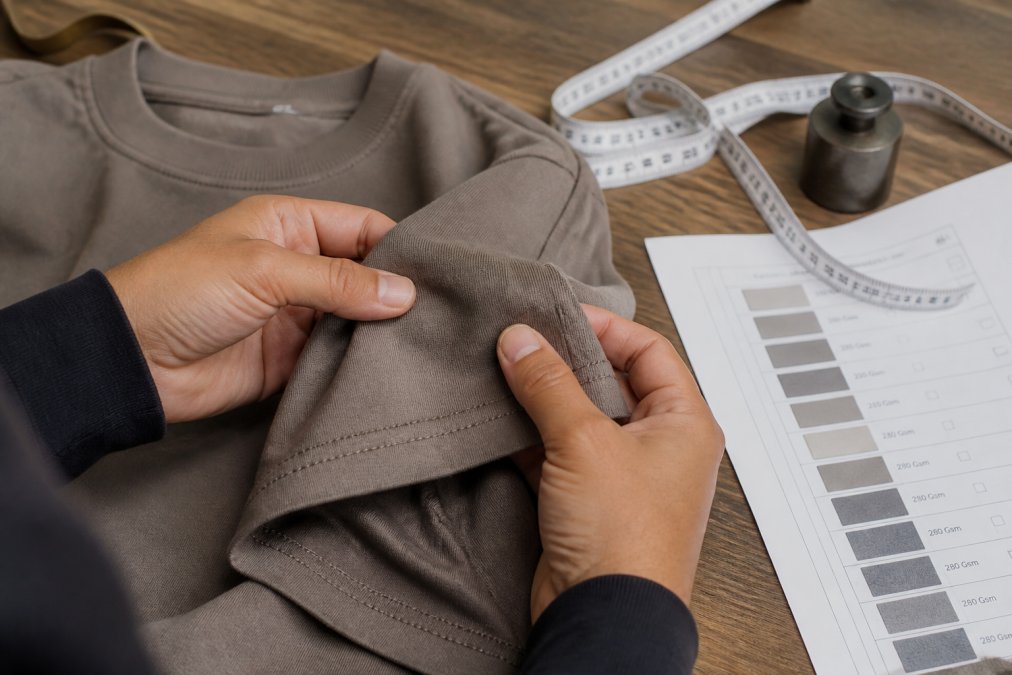
The Stretch Test, the Light Test, and the Seam Pull
Stretch the fabric sideways across your chest. Quality cotton snaps back. Cheap cotton stays stretched and warped.
Hold the shirt up to a light source. If you can see your hand clearly through the body, the fabric is too thin to survive regular wear.
Grip both sides of a shoulder seam and pull gently. A garment with double-needle stitching holds firm. Single-stitched seams separate and pucker within weeks.
Finally, rub the fabric between your fingers. Ring-spun cotton feels dense and smooth. Open-end cotton feels rougher and thinner, and it pills faster.
Streetwear Fabric Guide: Cotton, Fleece, and Blends That Hold Up
Heavyweight cotton, French terry, and cotton-poly fleece are the three fabrics that define durable streetwear. Everything else is a compromise or a cost-cutting shortcut dressed up in marketing language. Learn the technical vocabulary on the tag, those terms describe real mechanical differences in how the yarn was spun, how the fabric was knit, and how it behaves after fifty washes.
Ring-Spun Cotton vs. Open-End Cotton
Ring-spun cotton is made by twisting fibers tightly during spinning, which produces a smoother, stronger yarn (Enhancing the quality of elastane-cotton core yarn by compact spinning). Open-end cotton (also called rotor-spun) is faster and cheaper to produce, but the resulting fabric is weaker and rougher.
The difference is not just feel: ring-spun fabric resists pilling and holds print detail far better over time. If you plan to wear a graphic tee weekly for years, this matters more than the design itself.
Ring spinning combs and aligns fibers before twisting, so fewer short fibers stick out to rub together and form pills. Open-end spinning skips the combing step, which is why it costs less and pills faster. A 100% combed ring-spun cotton tee at 180-200 GSM will outlast a 100% open-end tee at the same weight by a wide margin, even though the two look identical on the hanger.
French Terry vs. Fleece vs. Cotton-Poly Blends
The back of a sweatshirt tells you which of the three you are holding.
- French terry has visible loops on the inside, like the back of a towel. It breathes, wicks moisture, and does not overheat indoors. It is the fabric behind most premium crewnecks and lighter hoodies.
- Brushed fleece has had those loops napped into a soft, fuzzy pile. It traps more heat, feels plusher, and pills more easily because the brushed fibers are loose.
- Cotton-poly fleece blends the two fibers to trade a little softness for durability and shrink resistance. A 50/50 or 80/20 cotton-poly blend holds its shape and size through repeated washing far better than 100% cotton fleece, which is why so many heavyweight hoodies use it.
Fabric Weight, Ounces, and GSM in Plain Terms
GSM (grams per square meter) and oz/yd² (ounces per square yard) both measure fabric weight, and the two convert roughly at 1 oz/yd² ≈ 33.9 GSM. A standard 6 oz/yd² tee is about 203 GSM. A 10 oz/yd² hoodie body is about 339 GSM.
| Fabric | Typical Weight | What It Signals |
|---|---|---|
| Lightweight jersey | 4.0-4.5 oz/yd² (135-150 GSM) | Sheer, prone to stretching |
| Midweight jersey | 5.0-6.0 oz/yd² (170-200 GSM) | Everyday tee range |
| Heavyweight jersey | 6.5-8.0 oz/yd² (220-270 GSM) | Structured, holds shape |
| French terry | 8.0-10.0 oz/yd² (270-340 GSM) | Premium sweatshirt range |
| Heavyweight fleece | 10.0-14.0 oz/yd² (340-475 GSM) | Cold-weather, structured hoodie |
A 240 GSM tee drapes differently than a 150 GSM one. It holds its shape. It resists the sheer, stretched-out look that cheap cotton develops after a few washes.
Pre-Shrunk, Combed, and Compacted: Three More Tag Terms Worth Knowing
- Combed cotton has had short fibers and impurities combed out before spinning, which is why it feels smoother and pills less than standard cotton.
- Pre-shrunk means the fabric was washed or steamed before cutting, so the finished garment should shrink less than about 2-3% in a cold wash instead of the 5-8% typical of untreated cotton.
- Compacted cotton is run through rollers that press the fabric flat, which reduces torque and helps the tee stop twisting in the wash.
These terms are not marketing fluff, they describe real steps in the mill. When a tag lists them together ("100% combed ring-spun cotton, pre-shrunk, 6.5 oz"), the manufacturer expects the buyer to know what they mean.
Construction Details That Separate High Quality Streetwear From Fast Fashion
Double-needle stitching, reinforced shoulder taping, and matched thread tension separate high quality streetwear from disposable fast fashion. The differences are small on the hanger and enormous after fifty washes.
Double-Needle Stitching and Seam Integrity
Double-needle stitching runs two parallel rows of thread along hems and seams, distributing stress across a wider area so the fabric resists tearing at the points that flex most.
Single-needle stitching is the giveaway of a budget garment. Check the bottom hem of a tee and the side seams of a hoodie. If you see one thin row of thread, expect it to unravel.
Seam integrity also depends on thread quality and stitch density. Run your fingernail along the inside of a seam. A tight, even stitch line holds. A loose, uneven one is a warning sign.
Print Longevity and Hardware: What Lasts Past 50 Washes
Screen printing, embroidery, and quality hardware outlast cheap heat-transfer prints and plastic zippers by years, not months. You do not need to wait fifty washes to find out which one you are holding, you can test the print and hardware in the fitting room in about thirty seconds.
The Four Print Methods and How They Fail
- Plastisol screen print pushes a thick PVC-based ink through a mesh screen and cures it into the fabric weave. It stretches with the shirt, holds color, and is the standard for durable graphic tees. It feels slightly raised at first and softens with wear.
- Water-based screen print uses thinner ink that soaks into the cotton rather than sitting on top. It feels like the shirt itself, fades gradually, and is prized for a vintage hand-feel, but it is less opaque, so dark shirts need more passes.
- Heat-transfer / DTG (direct-to-garment) print bonds a printed film or deposits ink droplets onto the surface. Cheap for small runs and full-color photos, but the bond is mechanical, so it cracks and peels at the flex points, shoulders, chest, and anywhere the shirt folds.
- Embroidery stitches thread directly into the garment, surviving years of washing without cracking because there is no film to crack. Cheap embroidery instead puckers the fabric around the design or uses low-density stitching that pulls loose.
How to Test a Print Before You Buy
- The stretch test. Pinch the printed area and pull gently in two directions. A plastisol or water-based print stretches with the fabric and springs back. A heat-transfer print will show hairline cracks along the pull line.
- The fingernail test. Drag a fingernail across the edge of the print. If it catches on a raised plastic lip, you are feeling a transfer film that will lift. If it glides over fabric, the ink is in the weave.
- The inside feel. Turn the shirt inside out and rub the back of the print. A soft, fabric-like feel means the ink cured into the cotton. A slick, rubbery, or waxy feel means a film is bonded to the surface.
- The fold test. Fold the shirt along the print and press. A transfer print will crease and leave a visible white line where the film cracked. A screen print will not.
Hardware: Zippers, Eyelets, Drawcords, and Aglets
Hardware is the fastest tell on a hoodie or jacket because it is expensive to upgrade and cheap to fake.
- Zippers. A quality zipper has a metal or molded-resin body with a smooth pull and a self-locking slider that does not drift down on its own. YKK is the most widely recognized zipper manufacturer, and many brands stamp the pull or the tape with the YKK mark. A generic unbranded zipper with a thin stamped pull is a cost signal.
- Eyelets and grommets. Metal eyelets on hoods and drawcord exits should be set flush against the fabric with no rough edges. Plastic eyelets crack at the rim within a season.
- Drawcords and aglets. Reinforced drawcord tips (aglets) are metal, heat-shrunk, or tightly wrapped. Cheap aglets are glued plastic that slides off in the wash, leaving a frayed cord end.
- Buttons and snaps. Metal shank buttons and branded snaps hold their finish. Painted plastic buttons chip to reveal white plastic underneath.
- Ribbing at cuffs and hems. Quality ribbing uses a 2x2 or 2x1 knit with spandex blended in, so it snaps back after stretching. Cheap ribbing stretches out permanently and hangs loose within a few months.
Why This Matters More Than the Brand Name
A brand can change factories, switch blanks, or quietly downgrade a print method between seasons without changing the label. The print and hardware are the parts you can verify with your own hands in the store. Learn the four print tests and five hardware checks above, and you can evaluate a piece the way a production manager would, regardless of what the tag says.
Cost-Per-Wear: Why a $56 Hoodie Beats Three $20 Ones
Cost-per-wear is the price of a garment divided by the number of times you actually wear it. A $56 heavyweight hoodie worn 150 times costs about $0.37 per wear. Three $20 hoodies that fall apart after 30 wears each cost about $0.67 per wear, and you replace them every season.
Most shoppers compare sticker prices, not lifespans. A cheap hoodie that loses its shape, pills, and fades is not a bargain, it is a subscription to replacing the same item over and over.
This is also where the capsule wardrobe idea earns its keep. A small rotation of durable pieces, a heavyweight hoodie, a ring-spun tee, a structured cap, costs less over three years than a closet full of disposable alternatives.
| Garment | Price | Wears Before Failure | Cost-Per-Wear |
|---|---|---|---|
| Heavyweight hoodie | $56 | 150+ | ~$0.37 |
| Budget hoodie (x3) | $60 total | 30 each | ~$0.67 |
| Ring-spun tee | $30 | 100+ | ~$0.30 |
| Fast-fashion tee (x4) | $40 total | 25 each | ~$0.40 |
At Chrimsan Christian Clothing LLC, we build our pieces around this exact math. The I Follow Jesus Hoodie uses heavyweight cotton-poly fleece with a unisex fit and ribbed cuffs, and the I Follow Jesus Tee is cut from 100% combed cotton that is pre-shrunk to hold its shape wash after wash. The I Follow Jesus Dad Hat uses premium embroidered lettering that will not fade or peel, which is the hardware equivalent of a stitched seam.


If you want the full heavyweight statement piece, the CHRIMSAN 'Sacrifice' Limited Edition Hoodie is built on the same premium construction with a bold cross graphic meant to last.

Frequently Asked Questions
Does a higher price tag always mean better quality streetwear?
No. Price reflects brand markup, marketing spend, and retail positioning as much as build quality. A $120 hoodie from a hype brand may use the same 400 GSM fleece as a $56 one. Check the spec sheet: fabric weight, stitch type, and hardware material tell you more than the price tag. A heavyweight 100% combed cotton tee at $30 can outperform a $90 designer blank if the construction is solid.
How can I tell if a hoodie is high quality before buying online?
Look for four specs in the product listing: fabric weight (400+ GSM for heavyweight fleece), stitch type (double-needle at stress points), hardware (metal grommets and YKK-style zippers, not plastic), and fabric composition (ring-spun cotton or a cotton-poly blend). If the listing does not mention any of these, ask the seller directly. Brands that care about quality publish these details because they know informed buyers check them.
What GSM should I look for in a quality streetwear hoodie?
For a hoodie that holds its shape and feels substantial, aim for 400 GSM or higher. Midweight hoodies sit around 300-350 GSM and work for layering. Anything under 280 GSM will feel thin and lose structure after a few washes. French terry and heavyweight cotton fleece in the 400-500 GSM range are the sweet spot for durability without excessive bulk. Always check whether GSM refers to the finished garment or the raw fabric, since they differ.
How do I spot counterfeit streetwear from legitimate brands?
Check the stitching first: counterfeiters cut corners with single-needle seams and loose threads. Then inspect the hardware: genuine pieces use metal zippers with smooth action and branded pulls, while fakes use plastic. Look at the tag placement and font consistency; misspelled or blurry labels are a red flag. Finally, verify the seller is an authorized retailer. If the price is 60% below retail and the seller is unknown, treat it as counterfeit until proven otherwise.
The real challenge is not finding streetwear that looks good on day one. It is finding pieces that still look good after a year of washes, workouts, and everyday wear. Chrimsan Christian Clothing LLC builds faith-forward apparel around heavyweight construction, combed cotton, and embroidered detailing so your wardrobe holds up as boldly as your message. Shop the collection and invest in pieces made to last.