

Table of Contents
- Why Quality Matters in Cotton Hoodies
- How to Spot High Quality Streetwear: The Fabric Foundation
- How to Check Hoodie Stitching Quality and Construction
- Durability and Post-Wash Performance Indicators
- Sustainability and Ethical Manufacturing Certifications
- Your Quality Inspection Checklist
- Frequently Asked Questions
Last Updated: September 28, 2026
Why Quality Matters in Cotton Hoodies
A cheap hoodie falls apart after three washes. A quality one lasts years. The difference isn't luck, it's in the details you can inspect yourself.
Customers who understand fabric quality make better purchasing decisions and get genuine value from their purchases.
This guide teaches you to perform a quality check for cotton hoodies by spotting construction flaws, evaluating durability, and verifying ethical manufacturing, with a checklist for every purchase.
How to Spot High Quality Streetwear: The Fabric Foundation
A quality hoodie's foundation is its fabric; everything else, stitching, hardware, durability, depends on material built to last.
Understanding GSM and Fabric Weight
GSM (grams per square meter) measures fabric density. Higher GSM means thicker, more durable material.
For cotton hoodies, here's what you need to know:
- Lightweight (under 300 GSM): Thin, prone to pilling and tears. Avoid these.
- Midweight (300-400 GSM): Good balance of comfort and durability. Most quality hoodies sit here.
- Heavyweight (400+ GSM): Thick, warm, long-lasting. Best for cold climates and frequent wear.
When you pick up a quality hoodie, it should feel substantial. If it feels paper-thin, the GSM is too low.
Check the product tag. If GSM isn't listed, ask the manufacturer, reputable brands always know their fabric weight.
Cotton vs Polyester Blend Hoodies: What's the Difference?
Pure cotton breathes and feels soft but shrinks easily. Polyester resists shrinkage and holds color but traps heat and feels plasticky.
Most quality hoodies blend the two:
- 100% cotton: Breathable, soft, but high shrinkage risk. Needs careful washing.
- 80/20 cotton-poly blend: Best balance. Cotton comfort with polyester durability.
- 50/50 blend: More polyester means better shape retention but less breathability.
- Cotton-poly fleece: Adds brushed loops on the inside for warmth and softness.
The blend determines post-wash performance. Pure cotton may shrink a full size; an 80/20 blend typically shrinks only 3-5%.
When evaluating a quality check for cotton hoodies, ask about the exact blend and read the tag carefully, don't assume "cotton hoodie" means 100% cotton.
Evaluating Yarn Quality and Texture
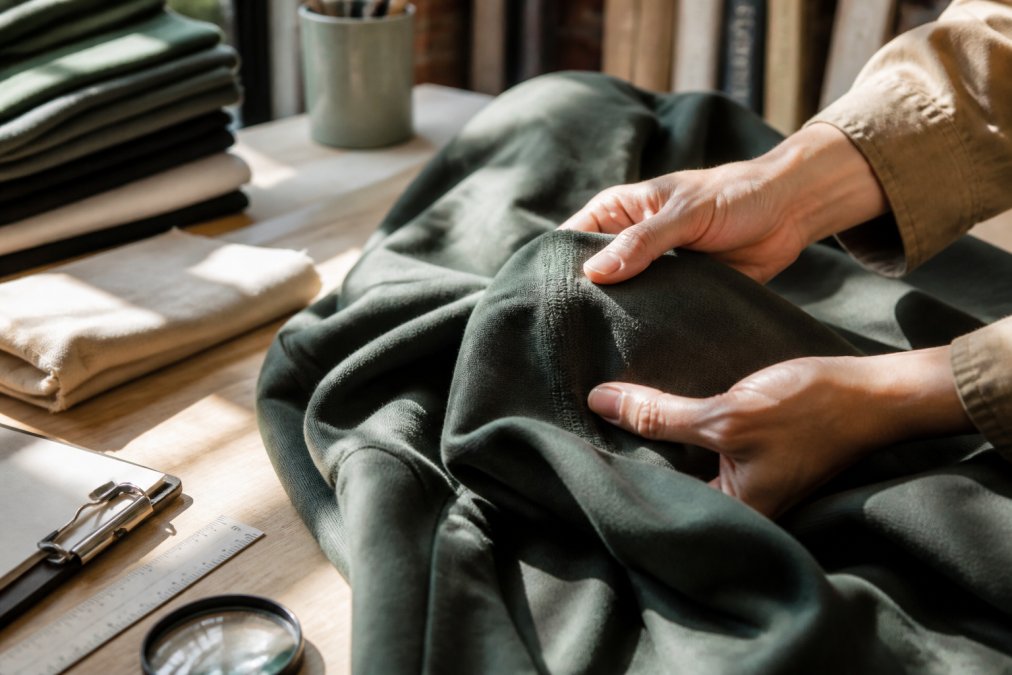
Feel the hoodie's surface. Does it feel smooth or rough? Is the texture consistent, or are there thin spots?
Quality hoodies use combed ring-spun yarn, which removes short fibers and aligns long ones, creating softer, stronger fabric that resists pilling.
Cheaper hoodies use carded yarn, which is faster to produce but creates a rougher surface that pills easily.
Run your hand across the fabric. High-quality yarn feels smooth and consistent; lower-quality yarn feels bumpy or uneven with thin spots or loose weave areas.
Quality fleece should feel soft and dense without shedding fibers when rubbed; shedding indicates improper brushing.
How to Check Hoodie Stitching Quality and Construction
Construction determines whether your hoodie survives real-world wear. Poor stitching fails in weeks; quality stitching holds for years.
Inspecting Seams and Stitch Integrity
Turn the hoodie inside out. Look at every seam.
Quality seams have these characteristics:
- Straight lines: No wavering or skipped stitches.
- Even spacing: Stitches are consistent distance apart (typically 2-3mm).
- No loose threads: All threads are secured. No fraying edges.
- Proper tension: Stitches don't pucker or bunch the fabric.
- Reinforced stress points: Armholes, shoulder seams, and pocket attachment have extra stitching.
Run your finger along seams, you should feel smooth stitching with no bumps or loose sections.
Pay special attention to the neckline, which gets stretched constantly. Quality hoodies have a reinforced neck seam with multiple stitching passes that feel rock solid.
Inspect the hem at the bottom.
Checking Hardware and Drawstring Quality
Quality drawstrings are thick (nylon or cotton cord), properly secured at both ends, and have reinforced eyelets with metal or plastic rings.
Durability and Post-Wash Performance Indicators
Post-wash performance reveals whether the manufacturer used quality materials and proper construction. Run a standardized home test before bulk purchases.
The Pre-Purchase Home Test Protocol
For new brands, request a sample and run this test before ordering in volume.
Christian Heavyweight Hoodie — I Follow →
Step 1: Baseline Documentation (Before Wash)
- Measure length, chest width, and sleeve length to the nearest ¼ inch.
- Photograph the fabric surface under natural light.
- Rub a white cloth across the fabric for 30 seconds and check for loose fibers or dye transfer.
- For graphics, rub the print with a dry cloth for 10 seconds and check for ink transfer.
Step 2: Wash Cycle
- Wash in cold water (60-70°F) with similar colors using standard detergent (no bleach or fabric softener). Cold water reveals whether dye is properly bonded.
- Dry on medium heat for 45 minutes or air-dry flat.
Step 3: Post-Wash Measurements and Inspection (Within 2 hours of drying)
- Measure again and calculate shrinkage: (Original - New) ÷ Original × 100. Acceptable: 0-3%; concerning: 3-5%; unacceptable: 5%+.
- Count visible pills on a 4-inch × 4-inch chest section. Quality hoodies: 0-2 pills; poor quality: 5+ pills.
- Check for color fading and graphic print damage (cracking, peeling, color loss).
- Rub fabric with a white cloth and compare fiber shedding to baseline.
Step 4: Shape and Fit Inspection
- Put on the hoodie, it should feel nearly identical to when new. Check the neckline (not stretched or saggy), cuffs, and waistband (original tension, not rigid or loose).
- Inspect seams for puckering or separation.
Step 5: Documentation and Decision
- Record measurements, pill counts, and observations.
- Pass: shrinkage under 3%, minimal dye transfer, light pilling, maintained fit. Fail: any metric exceeds acceptable thresholds.
Pilling, Shrinkage, and Shape Retention
Pilling occurs when short fibers work loose and tangle into fuzzy balls. Quality fabrics resist pilling; cheap fabrics pill aggressively.
- Stable fabric: Proper weave density prevents stretching.
- Reinforced seams: Strong stitching holds the garment structure.
- Quality elastic: Ribbed cuffs and waistbands stay tight without becoming rigid.
Colorfastness and Graphic Print Durability
Colorfastness means the dye stays in the fabric. Poor dyes bleed or fade quickly.
Quality hoodies use dyes that:
-
Don't bleed: Other clothes won't get stained when washed together. Test this by washing with a white cloth and checking for color transfer.
-
Don't fade: Color remains vibrant after 20+ washes. The home test protocol above documents baseline color and post-wash color for comparison.
-
Bond properly: Dye molecules are locked into the fiber structure. This is why quality dyes don't bleed in cold water.
-
Don't crack or peel: Ink stays bonded through hundreds of washes. After the home test wash, inspect the print closely under light. Quality prints show no cracking, peeling, or separation.
-
Don't fade unevenly: Color fades evenly, not in patches. Compare post-wash print color to baseline photos.
-
Maintain sharp edges: Print edges stay crisp, not blurry or separated. This indicates proper ink adhesion and curing.
When to Request a Manufacturer's Test Report
For bulk orders, reputable manufacturers can provide:
- Shrinkage test results: Measured per AATCC (American Association of Textile Chemists and Colorists) Test Method 135, which is the industry standard. Results should show shrinkage under 3% for quality hoodies.
- Pilling test results: Measured per ASTM D3884 (Martindale abrasion test). Quality fabrics show minimal pilling after 10,000 cycles.
- Colorfastness test results: Measured per AATCC Test Method 8 (washing) or Test Method 16 (rubbing). Results should show color fastness of 4 or higher on a 5-point scale.
- Tensile strength test results: Measured per ASTM D6775. This confirms the fabric can withstand normal wear without tearing.
If a manufacturer cannot provide these test reports, they likely don't have quality control processes in place. Reputable brands test their fabrics and keep records.
Sustainability and Ethical Manufacturing Certifications
Fair Trade Certified: Ensures workers are paid fairly and work in safe conditions. Fair Trade certification is verified by independent auditors.
Your Quality Inspection Checklist
Use this checklist every time you evaluate a cotton hoodie:
Fabric Quality
- GSM is listed (aim for 300+ for quality)
- Blend is specified (80/20 cotton-poly or better)
- Surface feels smooth and consistent
- No thin spots or loose weave areas
- Fleece is dense and doesn't shed fibers
Construction
- Seams are straight with even stitch spacing
- No loose threads or fraying
- Neckline seam is reinforced
- Hem is finished and won't unravel
- Drawstring is thick and properly secured
- Eyelets are reinforced with metal or plastic rings
Durability Indicators
- Fabric resists pilling when rubbed
- Blend minimizes expected shrinkage
- Dyes don't bleed on white cloth
- Graphics don't crack or peel when rubbed
- Elastic maintains tension without being rigid
Ethical Standards
- Manufacturer is named and traceable
- At least one certification is present (Fair Trade, GOTS, OEKO-TEX, or SA8000)
- Care instructions are clear and specific
Frequently Asked Questions
How do I tell if a hoodie is good quality?
Check four key areas: fabric weight (look for 300+ GSM for durability), stitching consistency (seams should be straight with 2-3 stitches per inch), material composition (combed ring-spun cotton resists pilling better), and hardware quality (zippers and drawstrings should feel substantial). A quality hoodie holds its shape after washing and shows no loose threads or seam separation.
What's the difference between cotton and polyester blend hoodies?
100% cotton hoodies offer superior breathability and softness but shrink more easily and require careful washing. Cotton-polyester blends (typically 80/20 or 70/30) provide better shape retention, reduced shrinkage, and increased durability while maintaining comfort. Polyester adds synthetic strength but can reduce moisture-wicking. Choose based on your priority: pure comfort favors cotton; durability and low-maintenance favor blends.
Should I buy a 100% cotton hoodie or a blend?
It depends on your needs. Pure cotton works best if you prioritize softness and breathability and don't mind hand-washing or using cold water. Blends are ideal if you want durability, minimal shrinkage, and machine-wash convenience. Many premium hoodies use combed ring-spun cotton blended with polyester to balance natural feel with practical performance.
What does GSM mean for hoodie quality?
GSM (grams per square meter) measures fabric weight and density. Lightweight hoodies are under 200 GSM, midweight range from 200-300 GSM, and heavyweight exceed 300 GSM. Higher GSM generally means better durability, warmth, and longevity, but also more bulk. For cotton hoodies, 250-350 GSM provides the sweet spot between comfort and durability.