

Table of Contents
- Why Christian Apparel Is More Expensive Than Fast Fashion
- Ethical Manufacturing in Faith-Based Fashion
- Small Batch Production and Custom-Made Costs
- How to Spot High Quality Streetwear
- Premium Christian Clothing Brands and Their Value Proposition
- Cost Breakdown: What You're Actually Paying For
- Durability and Cost-Per-Wear Analysis
- Conclusion
- Frequently Asked Questions
Last Updated: October 2, 2026
Why Christian Apparel Is More Expensive Than Fast Fashion
Why is christian apparel expensive? Because it costs more than fast fashion due to intentional choices: ethical manufacturing, small-batch production, premium materials, and custom design labor. It's not arbitrary markup.
At Chrimsan Christian Clothing LLC, every decision, from cotton weight to embroidery technique, reflects investment in quality and values. The I Follow Jesus Tee ($30) and Hoodie ($56) are built to last under conditions that respect workers and materials.

This guide breaks down where your money goes when you invest in quality Christian apparel.
Ethical Manufacturing in Faith-Based Fashion
Ethical manufacturing is the foundation of premium Christian apparel pricing. Fair labor practices, fair wages, safe conditions, worker dignity, are direct costs that scale into your final price.
Faith-based brands reject fast fashion's model of undervalued labor. They source from manufacturers with verified supply chains, reasonable production volumes, and fair wages, costs that add up.
Christian apparel brands view ethical manufacturing as inseparable from faith values. Treating workers as humans, not production units, means accepting higher labor costs.
Small Batch Production and Custom-Made Costs
Made-to-order production is a major cost driver. Chrimsan crafts each piece specifically for your order rather than manufacturing massive runs and warehousing inventory.
Small-batch production means higher per-unit costs. A factory producing 10,000 identical hoodies spreads fixed costs across all units; a brand making 200 hoodies cannot achieve the same economy of scale.
Custom design work amplifies costs. Personalized messages and color combinations require design consultation, mock-ups, and skilled labor. Chrimsan's 14-day production window reflects thoughtful, made-to-order production.
How to Spot High Quality Streetwear
Quality streetwear feels substantial. Heavyweight cotton-poly fleece (like the I Follow Jesus Hoodie) has built-in density and durability. Combed cotton, used in premium tees, resists pilling and fading better than standard cotton.

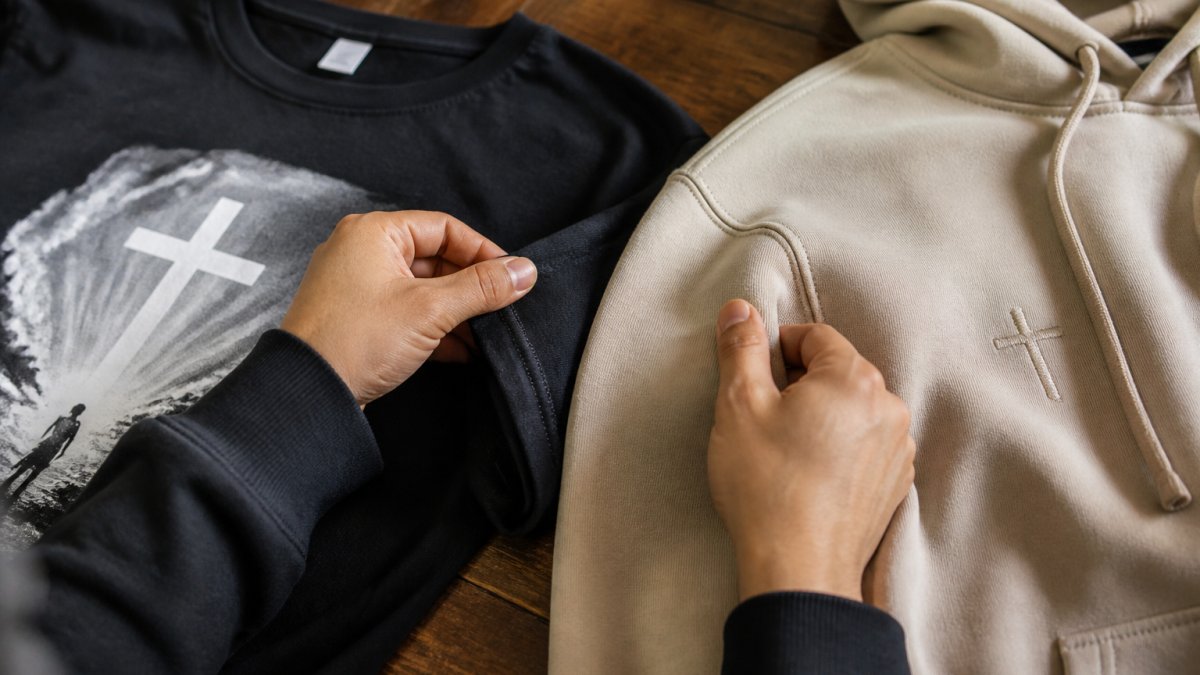
Stitching quality is critical. Look for tight, even seams with no loose threads. Premium screen printing has crisp edges and vibrant color that resists cracking. Embroidery should have tight, even stitches with no gaps.
Quality brands print clear care instructions and fiber content. Pre-shrunk fabric is standard, meaning material is treated to minimize shrinkage and maintain fit.
Premium Christian Clothing Brands and Their Value Proposition
The Secular Boutique Comparison Premium combed-cotton tees from Christian brands and secular boutique brands are priced similarly: $28-$35. The I Follow Jesus Tee at $30 aligns with secular equivalents like Everlane and Buck Mason.

The perception that Christian apparel is expensive stems from comparing $30 Christian tees to $12 fast-fashion tees, not to $30 secular boutique tees.
Where Christian Brands Differ: Mission Alignment Over Price Christian brands compete on values alignment and quality, not price. Consumers seek pieces reflecting their identity and supporting mission-aligned businesses.
Christian brands position themselves around authenticity and purpose. Some donate 5-15% of profits to faith-based charities; others prioritize community engagement.
Chrimsan's focus on contemporary designs for believers reflects a choice to make faith-forward fashion accessible to young adults and fitness-focused individuals.
The 'Ministry Tax' Myth Some brands exploit faith positioning to charge unjustified premiums. Transparent Christian apparel brands counter this by explaining costs openly.
Compare Christian brands to secular boutique brands with equivalent materials and production. If prices differ by 5-10%, the difference reflects custom production or charitable giving, not a "faith tax."
Quality and Longevity as the Real Value Proposition The value proposition also includes durability.
Christian Heavyweight Hoodie — I Follow Jesus | Chrimsan →
A $30 Christian tee that lasts 300+ wears (worn twice weekly for three years) costs $0.10 per wear. A $12 fast-fashion tee that lasts 30 wears costs $0.40 per wear.
Cost Breakdown: What You're Actually Paying For
Understanding where your money goes demystifies why Christian apparel costs what it does. Rather than abstract percentages, here's how the economics actually work using a real example: the I Follow Jesus Tee at $30.
Materials & Fabric (approximately $7-$8, or 23-27%) A premium combed cotton blank (the unprinted tee before any design is added) costs $4-$5 wholesale.
Labor & Production (approximately $8-$10, or 27-33%) This is where ethical manufacturing shows up in your price. Fair-wage production workers in facilities that meet safety and dignity standards earn significantly more than workers in low-cost overseas sweatshops.
Design & Artwork (approximately $3-$4, or 10-13%) Creating or licensing the "I Follow Jesus" graphic isn't free. Original design work, conceptualization, sketches, digital rendering, and refinement, typically costs $300-$800 per design.
Shipping & Fulfillment (approximately $2-$3, or 7-10%) Packaging materials (tissue, boxes, branded labels), logistics to your address, and customer service for tracking and returns all add up.
Profit & Reinvestment (approximately $3-$4, or 10-13%) After all costs, a healthy margin allows the brand to reinvest in better equipment, staff training, and mission-aligned giving.
Why the Numbers Don't Always Add Up to 100% Some brands operate at lower margins (8-10% profit) to keep prices down; others maintain higher margins (15-18%) for faster growth or larger charitable contributions.
The Transparency Test Legitimate faith-based brands can articulate where costs come from. If a brand won't explain why a tee costs $30 instead of $15, or won't name their manufacturing partners, that's a red flag. Chrimsan's willingness to discuss custom production timelines (14 days), material choices (heavyweight fleece, combed cotton), and the labor involved in made-to-order production reflects confidence in the value proposition. That transparency is itself a marker of quality.
Durability and Cost-Per-Wear Analysis
The real measure of value isn't the sticker price, it's how long a piece actually lasts and how often you wear it. Cost-per-wear is the metric that separates smart purchases from expensive mistakes.
A $30 tee that falls apart after 10 washes costs you $3 per wear if you only get 10 wears out of it. A $30 tee made from quality combed cotton that lasts 100+ washes costs you $0.30 per wear.
Durability starts with fabric selection. Heavyweight fleece, pre-shrunk cotton, and reinforced seams all contribute to longevity. Proper care extends durability further. Machine washing cold and tumble drying low, as recommended for pieces like the I Follow Jesus Hoodie, prevents premature wear and fading.
Consider the I Follow Jesus Tee at $30. If you wear it twice a week for three years (approximately 300 wears), your cost-per-wear drops to $0.10.
Durability also matters for faith-forward messaging. A graphic tee with a bold faith statement is more meaningful if it stays vibrant and holds its shape. Faded, stretched-out apparel undermines the message. Quality construction ensures your faith expression remains clear and intentional.
Conclusion
Why is Christian apparel expensive? Because it's built on different values than fast fashion. Ethical manufacturing, small-batch production, quality materials, skilled design work, and fair labor practices all have real costs. These aren't arbitrary markups, they're intentional investments in quality, values alignment, and longevity.
When you buy from Chrimsan Christian Clothing LLC, you're supporting a business model where workers are treated fairly, materials are sourced thoughtfully, and pieces are designed to last. The I Follow Jesus Hoodie, I Follow Jesus Tee, and I Follow Jesus Dad Hat are priced to reflect that commitment. Start with the Chrimsan I Follow Jesus Statement Bundle, which combines the tee, hoodie, and hat at a bundled price that saves $27 compared to buying separately. Each piece is custom-made to order, arriving in approximately 14 days, a timeline that reflects intentional production rather than rushed manufacturing.
Frequently Asked Questions
Why is Christian apparel more expensive than standard streetwear brands?
Christian apparel costs more because ethical manufacturers, fair labor practices, premium material sourcing, and small-batch production all add to the final price. Unlike fast fashion, faith-based brands prioritize supply chain transparency and garment quality over volume. Custom-made-to-order production also means each piece is crafted individually rather than mass-produced, which increases labor costs but ensures durability and care in every detail.
How can you tell the difference between high-quality and low-quality Christian streetwear?
High-quality Christian apparel features reinforced stitching, premium fabric blends (like heavyweight cotton-poly fleece), consistent graphic printing or embroidery that won't fade, and detailed construction. Check for pre-shrunk fabric, proper seam finishing, and adjustable fits. Low-quality pieces use thin cotton, single-ply stitching, and printed designs that crack after a few washes. Examine product descriptions for material specifics, care instructions, and manufacturing transparency, brands that hide their sourcing practices typically cut corners on quality.
Does paying more for Christian apparel actually mean it will last longer?
Yes, when you buy from ethical manufacturers using premium materials. Heavyweight fabrics, reinforced seams, and quality dyes resist fading and deterioration through multiple wash cycles. The cost-per-wear on a $56 hoodie worn 100 times over two years is about 56 cents per wear, comparable to or better than fast fashion pieces that fall apart after 20-30 wears. Proper care (cold water washing, low heat drying) extends the life even further, making premium Christian apparel a practical investment, not just a faith statement.
Are Christian clothing brands actually ethical in their manufacturing, or is that just marketing?
Legitimate faith-based brands demonstrate ethics through supply chain transparency, fair labor practices, and small-batch production. Ethical manufacturers pay workers fairly, maintain safe working conditions, and often source materials responsibly. Brands that operate custom-made-to-order systems (rather than dropshipping) have direct control over production quality and labor standards. Look for brands that publicly share their manufacturing practices, material sourcing, and production timelines, transparency is a sign of genuine commitment to values beyond the price tag.
Quality Christian apparel isn't a luxury, it's an investment in pieces that align your wardrobe with your values. When you understand the economics behind faith-forward fashion, the pricing makes sense. You're not just buying a tee or hoodie; you're supporting ethical manufacturing, fair labor, and sustainable production practices. That's worth the premium.